Neurofeedback for Anxiety: A Brain-Training Approach to Nervous System
Regulation
Neurofeedback is a brain-training method that uses real-time information from EEG sensors to help the brain observe its own activity and gradually become more flexible and self-regulating. For people with anxiety, neurofeedback training is most often used as a complementary brain-training practice to support the nervous system’s ability to shift out of stress patterns and recover its baseline more easily.
It does not force the brain to relax. It does not chemically alter the brain. It is not a treatment foran anxiety disorder, not a cure, and not a substitute for psychotherapy, cognitive behavioral therapy (CBT), medication, or any care from a licensed healthcare provider.
This guide covers what neurofeedback brain training is, how it works, the differences between consumer EEG headsets, protocol-based systems, and Dynamical neurofeedback, what current research shows for anxiety, what a program looks like in practice, and how to decide whether brain training might fit alongside your existing anxiety support.
Licensed Psychotherapist · Advanced NeurOptimal® Trainer · Amen Clinic Brain Health Coach
Natalie has over 25 years of experience as a licensed psychotherapist and has been a NeurOptimal® neurofeedback trainer since 2011. She is the founder of Neurofeedback Training Co. and specializes in anxiety, trauma, ADHD, and stress-related nervous system dysregulation.
.png)
What is neurofeedback brain training?
- Shift out of stress patterns more readily
- Recover from emotional spikes more quickly
- Reduce the intensity of anxious rumination
- Improve sleep consistency
- Build greater overall flexibility and resilience

Three things to be clear about up front:
Brain training, not medical treatment. The equipment only reads brainwaves. It does not deliver any electrical signal, magnetic pulse, or stimulation to the brain. Non-entrainment systems do not use direct electrical current methods.
Brain training does not “fix” anxiety. Anxiety disorders benefit from a multi-pronged support approach. Neurofeedback is one possible piece of that approach, not a replacement for psychotherapy, CBT, medication, or care from a licensed mental-health provider.
Outcomes vary. Some people respond strongly to brain training; others do not. Individual response depends on consistency, baseline, fit, and many other factors
Anxiety and the nervous system
Anxiety is, at its core, a nervous-system pattern. The brain interprets a cue as a threat real, remembered, or imagined and the body shifts into a stress response. Heart rate rises, breath becomes shallow, attention narrows, the prefrontal cortex quiets while the limbic system takes over. For most people that response is brief: the threat passes, and the system settles back down.
In anxiety, the system gets stuck. It can fire too easily, stay activated too long, or cycle betweenactivation and shutdown without fully resourcing in between. Over time the brain learns the pattern, and the pattern becomes the default.
Neurofeedback aims to support the brain’s ability to notice that it has slipped into an inefficient stress pattern and to self-correct - rather than override the symptoms directly. The goal is greater flexibility, not forced calm. This is why neurofeedback is described as a self-regulation skill, not a symptom suppressor.
Different neurofeedback systems take very different approaches to supporting that self-regulation. The next section explains the three categories you’ll encounter when researching options.
Two generations of neurofeedback (and where consumer headsets fit)
Not all neurofeedback systems are the same. Professional neurofeedback has two main generations of technology, plus a separate category of lower-tier consumer devices. The
differences matter particularly for anxiety-focused brain training, where the choice between approaches affects what a program looks like, how it’s delivered, and what the underlying design is intended to do.
First generation: Linear / protocol-based neurofeedback
Linear neurofeedback was the first generation of professional EEG biofeedback systems. The approach:
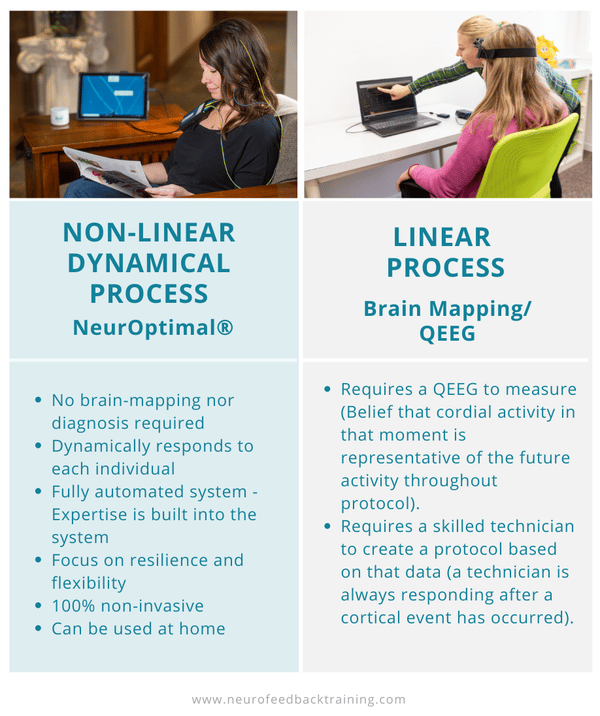
• A neurofeedback trainer first takes a brain map (QEEG) of the brain’s electrical patterns
• That map is used as a reference point to set training protocols
• Protocols target specific frequency patterns to migrate the brain toward more typical,
healthier patterns (for anxiety, often involving alpha or sensorimotor-rhythm training)
• Trained practitioners adjust protocols manually as training progresses, typically with updated brain maps every few months
Linear / protocol-based neurofeedback is well-established and remains the foundation of much of clinical practice. Its trade-offs are that the protocol must be set ahead of time by a clinician, must be adjusted manually as goals shift, and is targeted at specific frequencies rather than the brain’s overall pattern of self-regulation.
Second generation: Dynamical / non-linear neurofeedback
The second generation of neurofeedback emerged as computing power approached the speed of the brain’s own processing. Dynamical neurofeedback is based on non-linear mathematics and was originally conceived by Dr. Valdeane Brown in the early 1970s; the technology only reached its fully intended form around 2005, when laptop-class computing was finally fast enough to monitor brainwave activity at micro-second resolution in real time.
Rather than targeting specific frequencies set by a protocol, a Dynamical system monitors the brain’s full EEG activity in real time and provides feedback whenever it detects an inefficient shift. Instead of training a target frequency, it trains flexibility the brain’s capacity to notice and self-correct.
Key features of Dynamical / non-linear systems:
- No pre-session brain map or QEEG required
- No frequency target - feedback is informational, not directive
- The brain decides how to respond to the feedback
- NeurOptimal, the most widely-used Dynamical system, performs over 200,000 calculations per minute, factoring in changes in voltage, duration, amplitude, and frequency over time
- Most often delivered through brief auditory interruptions in music or sound, which reduces the need to focus on a screen — a meaningful benefit for people who already feel overstimulated
- No protocols to adjust between sessions, which makes consistent home use practical
- Designed for safe home use - no risk of over-training a specific frequency
For anxiety-focused brain training, the Dynamical approach has some practical advantages: no repeated brain maps required, no risk of over-training a specific frequency, and the auditory feedback format is gentler for someone whose nervous system is already running hot.
Our at-home rental program uses second-generation Dynamical neurofeedback - specifically NeurOptimal. It is the same system used in professional clinical settings, configured for home use and supported by weekly 1:1 coaching from a board-certified trainer.
A separate category: consumer EEG headsets
Consumer EEG headsets are a separate category from professional neurofeedback. Often marketed as focus or meditation devices, they typically:
- Use simplified metrics (often only one or two channels)
- Offer limited training flexibility
- Are not full professional-grade systems
- Generally do not include 1:1 coaching from a board-certified trainer
Consumer headsets can be useful for general awareness or meditation support, but for structured anxiety-focused brain training they are not in the same category as either first- generation protocol-based systems or second-generation Dynamical systems.
How a Dynamical neurofeedback session works
A Dynamical neurofeedback session looks like this:
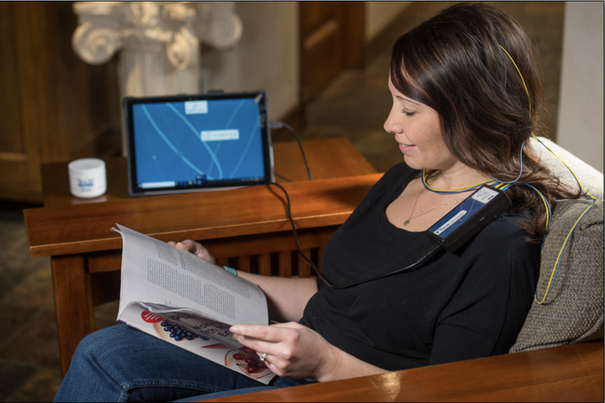
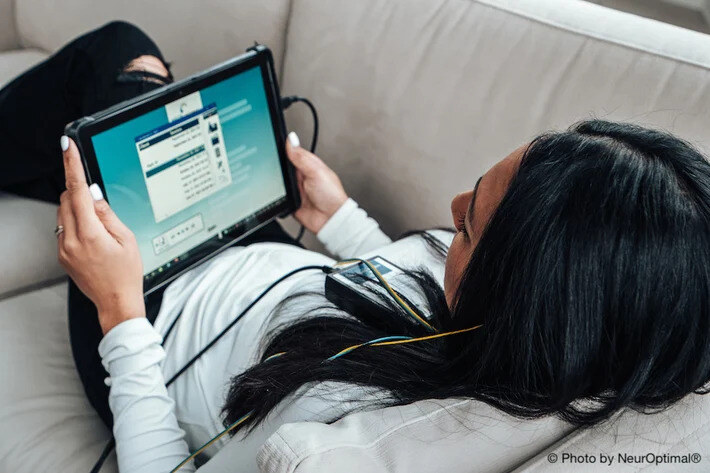
A few EEG sensors are placed on the scalp - usually two on the head and a few small clips on the ears. The session software plays music or a video. As the brain's activity is monitored, the system listens for moments of inefficiency - abrupt shifts, instability, patterns associated with distraction or stress. Whenever it detects one, it briefly interrupts the audio. The interruption is the information. The brain notices it, takes that information in, and gradually reorganizes.
The person doesn't have to actively "do" anything. They don't try to focus harder. They don't try to slow their thoughts. They simply receive the information and let the brain process it.
Most anxiety-focused neurofeedback programs:
- Use 30 or more sessions to support more sustained shifts
- Run sessions about 33 minutes long
- Are completed 2 to 4 times per week
- Take 8 to 16 weeks total to complete
What does the research say?
The research on neurofeedback for anxiety is encouraging but not definitive. Controlled studies and meta-analyses have reported measurable improvements in symptoms across several anxiety presentations generalized anxiety disorder, panic disorder, and specific phobias typically alongside other forms of care. Other studies, particularly larger randomized trials with sham controls, have shown smaller effects than expected, or effects that may be partly explained by non-specific factors such as consistent practice, structured routine, and dedicated time spent in a quiet, focused state.
A summary as of 2026:
- Several meta-analyses and clinical studies have found that neurofeedback training is associated with improvements in some anxiety-related symptoms, particularly when delivered with proper protocols and consistent attendance.
- Effect sizes vary substantially by study, by system type, and by population.
- Neurofeedback is not considered a standard first-line medical treatment for anxiety disorders. It is best understood as brain training that may complement CBT, psychotherapy, lifestyle changes, or medication when appropriate.
- Neurofeedback is not FDA-approved as a treatment for anxiety. It is regulated as a wellness practice for general brain training, not as a medical device for anxiety disorders.
The strongest predictor of benefit appears to be consistent participation in a properly-supervised program - regardless of which type of system is used nd integration with broader anxiety care.
What results can you realistically expect?
Results from neurofeedback brain training are rarely linear. Progress tends to come in shifts, not a steady curve. Many people describe it less as “anxiety going away” and more as “the same situations stop spiraling the way they used to.”
Early shifts (typically 10-20 sessions in) often include:
- Improved sleep quality
- Faster recovery after stressful events
- Reduced reactivity to small triggers
- Less rumination loops at night or first thing in the morning
- Slightly more spaciousness between a stressor and the reaction to it
Over a longer arc (40+ sessions), people commonly notice:
- Lower baseline anxiety, even on stressful days
- More resilience to triggers that previously caused panic or shutdown
- Easier access to the tools they’ve already been building in therapy
- More flexibility - the system doesn’t lock into stress patterns as easily
- Improved ability to be present rather than scanning for threat

Brain training supports nervous-system regulation capacity. It does not eliminate emotion, remove all stress, or rewrite personality. The goal is more flexibility and better self-regulation, not a different brain.
If you complete 20 sessions and notice nothing - no awareness shift, no subjective change - raise it with your trainer. Sometimes it means the approach needs adjusting. Sometimes it means brain training isn’t the right fit at this moment, and that’s also useful information.
Who might brain training be a fit for?
- Are already working with a therapist or healthcare provider on anxiety and want to add a complementary skill-building practice
- Want non-medication support, or to complement existing care, in coordination with their provider
- Notice that stress and reactivity worsen their anxious symptoms
- Find that traditional relaxation techniques alone don’t shift their nervous system far enough
- Have generalized anxiety, panic disorder, social anxiety, or specific phobias as part of their picture
- Prefer home-based flexibility over clinic visits
- Have time to commit to 8–16 weeks of regular practice
- Are looking for a fast or single-intervention solution
- Cannot reliably commit to 2–4 sessions per week
- Are in acute crisis and need immediate clinical support
- Want to replace existing anxiety care without consulting their healthcare provider

At-home Dynamical neurofeedback for Anxiety
Three factors matter most for results in home neurofeedback:
1. Frequency of sessions
2. Consistency over weeks
3. Appropriate system quality (professional-grade, not consumer)
Dynamical neurofeedback is particularly well-suited for home use because:
- There are no protocol adjustments required between sessions, so a board-certified trainer can support the program effectively from a distance.
- The system is designed for safety and flexibility, with no risk of over-training a specific frequency.
- The auditory feedback format is gentler for an already-overstimulated nervous system, and the session can be done in a quiet, familiar environment
- Equipment is professional-grade and configured for at-home setup
Historically, neurofeedback was only available in clinics, at typical costs of $100 to $200 per session - meaning $3,000 to $12,000 for a full program. For someone with anxiety, the additional friction of clinic appointments, transit, and a less familiar environment can be its own barrier. At-home Dynamical neurofeedback solves this with the same clinical-grade system, configured for home use and supported with weekly 1:1 coaching.
Cost and time commitment
|
Option |
Typical cost |
Time commitment |
|
In-clinic neurofeedback |
$3,000 - $12,000 for full program |
Travel + 30-min session, 3-5x/week |
|
At-home Dynamical rental (with coaching) |
Starting at $650/month, all-inclusive |
30-min session at home, 3-5x/week |
|
Consumer-tier headsets |
$300 - $1,500 device + apps |
Self-directed, varies |
Neurofeedback is generally not covered by insurance for anxiety because it is not FDA-approved as a treatment. Some clinics offer HSA/FSA eligibility under certain conditions; check with your specific plan provider.
How brain training fits alongside other anxiety support
Most people managing anxiety use more than one support strategy. Neurofeedback brain training is one option that can fit alongside others:
- Cognitive Behavioral Therapy (CBT). CBT is one of the most well-evidenced approaches for anxiety. It targets thought patterns and behaviors. Neurofeedback works at a different level - nervous-system regulation and many people find that the two reinforce each other. Brain training is not a substitute for CBT.
- Psychotherapy. Talk therapy supports insight, processing, and relational repair.
Neurofeedback can make the nervous system more available for that work. Brain training is not a substitute for psychotherapy. - Medication. Anxiety medications (SSRIs, SNRIs, benzodiazepines, beta blockers) chemically modulate neurotransmitter activity to reduce symptom intensity. Neurofeedback trains the brain to regulate itself more effectively, gradually, through repeated practice. Some people choose neurofeedback before exploring medication; some alongside; some after experiencing medication side effects. This is a personal decision that should be discussed with a medical provider. Neurofeedback is not a medical-treatment replacement.
- Mindfulness and somatic practices. Like neurofeedback, mindfulness practice builds awareness of nervous-system state. Many people find the two practices reinforce each other.
- Exercise. Regular aerobic exercise has well-documented benefits for anxiety symptoms.
- Sleep optimization. Sleep deprivation worsens nervous-system reactivity. Addressing sleep is one of the highest-leverage non-medical supports for anxiety
We do not position neurofeedback as a substitute for any of these. Brain training is one tool. The decision about which tools to use, in which combination, is best made in conversation with a healthcare provider.
Frequently asked questions about neurofeedback for anxiety
Does neurofeedback cure anxiety?
No. Neurofeedback does not cure anxiety. It is a brain-training process that aims to improve the brain's regulation capacity, which may reduce symptom intensity over time. It is not a substitute for psychotherapy, CBT, medication, or any other care from a licensed healthcare provider.
What is the difference between protocol-based and Dynamical neurofeedback?
They are two generations of professional neurofeedback technology. First-generation protocol-based (linear) neurofeedback uses a pre-set protocol, typically based on a QEEG/brain map, to target specific frequency patterns. Protocols must be adjusted by a clinician as training progresses. Second-generation Dynamical (non-linear) neurofeedback, such as NeurOptimal, does not target specific frequencies. It monitors the brain's full EEG activity in real time and provides feedback whenever it detects inefficient shifts, allowing the brain to self-correct. No brain map is required, and no protocol adjustments are needed between sessions, which makes Dynamical systems particularly well-suited for safe home use.
Does neurofeedback work for anxiety?
Research on neurofeedback for anxiety is generally encouraging but not definitive. Several meta-analyses and clinical studies have found that neurofeedback training is associated with improvements in symptoms across generalized anxiety disorder, panic disorder, and specific phobias. Effect sizes vary, and not everyone responds. The strongest predictor of benefit appears to be consistent participation in a properly-supervised program, ideally integrated with broader anxiety care.
Is neurofeedback a treatment for anxiety?
No. Neurofeedback is a brain-training method, not a medical treatment. It is not FDA-approved as a treatment for anxiety and should not be used as a substitute for diagnosis or care from a qualified healthcare provider. Many people use it as a complementary practice alongside CBT, psychotherapy, or medication.
How long does a neurofeedback program for anxiety take?
Most anxiety-focused neurofeedback programs run 8 to 16 weeks. Sessions are typically about 33 minutes long, completed 2 to 4 times per week. Some individuals notice changes within 10 to 20 sessions; more sustained shifts typically require 30 or more sessions.
How much does neurofeedback for anxiety cost?
In-clinic neurofeedback programs typically cost $3,000 to $12,000 for a full anxiety-focused
program. At-home Dynamical rental programs with weekly 1:1 coaching start at $650 per month, all-inclusive - usually less than half the cost of in-clinic. Consumer-tier headsets are cheaper but generally do not include professional protocols or coaching.
Can I do neurofeedback for anxiety at home?
Yes. Professional-grade Dynamical neurofeedback systems are well-suited for home use because they don't require protocol adjustments between sessions and have no risk of over-training a specific frequency. For anxiety in particular, being able to do sessions in a familiar, quiet environment can be an additional benefit. Home programs work best when paired with weekly 1:1 video coaching from a board-certified trainer.
Can neurofeedback make anxiety worse?
Temporary fluctuations can occur as the brain adjusts during training — for example, mild fatigue, vivid dreams, or short-lived emotional variability in the first few sessions. Systems designed for flexibility (such as Dynamical neurofeedback) are intended to support the brain's resourcing capacity rather than push it into a specific state, which is one reason they are considered safe for home use. Persistent worsening should always be raised with your trainer and your healthcare provider.
Is neurofeedback for anxiety covered by insurance?
Neurofeedback is generally not covered by insurance for anxiety because it is not FDA-approved as a treatment. Some clinics offer HSA/FSA eligibility under certain conditions; check with your specific plan.
Can neurofeedback replace anxiety medication or therapy?
No. Neurofeedback is brain training, not a medical treatment, and it is not a substitute for medication, CBT, or psychotherapy. Most people who use neurofeedback for anxiety use it as a complementary practice alongside their existing care, in coordination with their healthcare provider. Any change to a medication or therapy plan should be made with the prescribing or treating clinician — not based on neurofeedback alone.
Does neurofeedback help with panic attacks or specific phobias?
Research has explored neurofeedback for several anxiety presentations, including generalized anxiety disorder, panic disorder, and specific phobias. Reported benefits typically center on improved nervous-system flexibility and reduced reactivity rather than the elimination of symptoms. As with any anxiety presentation, brain training is best used alongside care from a qualified healthcare provider.
Is neurofeedback safe?
Neurofeedback is non-invasive. The equipment only reads brainwaves; it does not send any
electrical signal, magnetic pulse, or stimulation into the brain. Side effects, when reported, are
mild (such as temporary tiredness after a session, vivid dreams, or short-lived emotional
variability) and resolve quickly.
Get started with at-home Dynamical brain training for anxiety
If you’ve decided that brain training might fit your anxiety support plan and you’ve discussed
it with your healthcare provider - our at-home rental program gives you professional-grade
Dynamical equipment (NeurOptimal), weekly 1:1 coaching from a board-certified trainer, and a
personalized program built around your goals.
