Neurofeedback for PTSD: Research, Benefits, and Where It Fits in Trauma Care
A research-informed guide to neurofeedback for PTSD in adults, teens, and children and how it may fit alongside trauma therapy.
Neurofeedback for PTSD is a non-invasive brain training approach that some adults, teens, and children use alongside trauma-focused therapy. It is not a replacement for evidence-based PTSD treatment, and it is not FDA-approved to diagnose or treat PTSD.
Research on neurofeedback for PTSD is still developing. Studies suggest it may help with trauma-related patterns such as emotional reactivity, sleep disruption, attention problems, and difficulty settling after stress. The strongest evidence for PTSD treatment still supports trauma-focused therapies such as Cognitive Processing Therapy (CPT), Prolonged Exposure (PE), EMDR, and, when appropriate, medication.
Later in this guide, we’ll look at PTSD neurofeedback research, including Bessel van der Kolk’s work and the broader evidence base.

Licensed Psychotherapist · Advanced NeurOptimal® Trainer · Amen Clinic Brain Health Coach
Natalie has over 25 years of experience as a licensed psychotherapist and has been a NeurOptimal® neurofeedback trainer since 2011. She is the founder of Neurofeedback Training Co. and specializes in anxiety, trauma, ADHD, and stress-related nervous system dysregulation.
.png)
On This Page
- Where neurofeedback fits in PTSD care
- What neurofeedback may help with
- Protocols and neurofeedback systems clinicians may use
- Neurofeedback vs. EMDR for PTSD
- Bessel van der Kolk, The Body Keeps the Score, and neurofeedback for PTSD
- Understanding PTSD
- Complex trauma, comorbidity, and why diagnosis matters
- Evidence-based treatments for PTSD
- What the research actually says
- What our home neurofeedback program looks like
- Who our program is and isn’t for
- Frequently asked questions about neurofeedback for PTSD
Does neurofeedback help PTSD?
Neurofeedback is not a first-line treatment for PTSD, and it is not FDA-approved to diagnose or treat PTSD. The strongest evidence for PTSD treatment still supports trauma-focused therapies such as CPT, PE, and EMDR. However, research on neurofeedback for PTSD is promising, especially as an adjunctive support for emotional regulation, hyperarousal, sleep disruption, and difficulty settling after stress. For some people, neurofeedback may help make trauma-focused therapy more tolerable by supporting the nervous system’s ability to regulate.
Where neurofeedback fits with Trauma Care
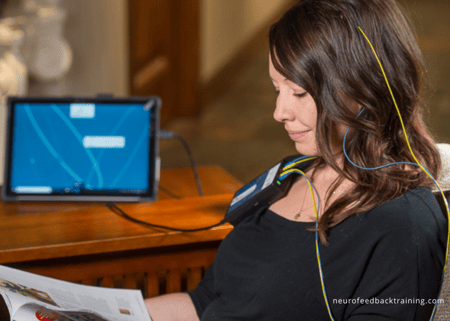
Neurofeedback is a brain training method. Sensors on the scalp record electrical activity (EEG); software detects patterns associated with regulated versus dysregulated states and provides real-time feedback - usually as a video, game, or sound - that rewards the brain for shifting toward a more regulated pattern. Over many sessions, the brain learns to self-regulate more readily.
Neurofeedback is not FDA-approved for the diagnosis or treatment of PTSD. It is not a replacement for trauma-focused therapy. With that clearly said, there is meaningful research and clinical experience suggesting neurofeedback can be a useful adjunct to standard PTSD care.
What neurofeedback may help with
• Hyperarousal - the chronic state of feeling on guard, jumpy, or activated
• Sleep - falling asleep, staying asleep, and reducing nightmare frequency for some clients
• Concentration and emotional reactivity - the ability to stay present in conversations, work, and parenting without being pulled into trauma-related responses
• Tolerance for trauma therapy work - some clients find that calming the nervous system through neurofeedback makes the harder work of CPT, PE, or EMDR more fluid
• Persistent symptoms after standard treatment — for adults whose progress in trauma-focused therapy has plateaued, neurofeedback is sometimes added as a complementary support
Protocols and Neurofeedback Systems Clinicians May Use
Several neurofeedback approaches have been studied or used clinically for trauma. Two have the strongest history with PTSD populations:
• Alpha-theta training. Developed in part through work by Eugene Peniston in the 1990s with combat veterans, alpha-theta is a deep-state training approach that supports nervous system regulation and processing of trauma-related material. Modern practitioners typically integrate alpha-theta with trauma therapy, not as a standalone intervention.
• Infra-low frequency training. Developed by Sue and Siegfried Othmer, this approach trains very slow brain activity and is widely used clinically for trauma, regulation, and sleep, though the published research base is smaller than for alpha-theta and the trauma-focused psychotherapies.
Other approaches — such as sensorimotor rhythm (SMR) training and individualized QEEG-guided protocols — may be used depending on the clinical picture and the assessment a healthcare provider conducts at the start of care.
Our program uses NeurOptimal® Dynamical Neurofeedback, a nonlinear neurofeedback system designed to provide real-time feedback to the brain without diagnosis-based protocols or practitioner-directed brainwave targets. For people exploring neurofeedback for PTSD or trauma-related symptoms, this means the training is not designed to treat PTSD directly. Instead, it is used as a brain training approach that may support regulation, flexibility, sleep, attention, and recovery from stress when appropriate. Learn more about how Dynamical neurofeedback works on our science page.
Neurofeedback vs. EMDR for PTSD: How Are They Different?
Neurofeedback and EMDR are sometimes discussed together because both are used by people looking for trauma-informed support. They are not the same type of approach.
EMDR, or Eye Movement Desensitization and Reprocessing, is a trauma-focused psychotherapy. It is designed to help people process traumatic memories, reduce distress connected to those memories, and change the way the brain and body respond to trauma reminders. EMDR is one of the evidence-based therapies commonly recommended for PTSD when provided by a trained mental health professional.
Neurofeedback is a brain training method, not psychotherapy. It does not require a person to talk through traumatic memories or intentionally revisit the trauma. Instead, neurofeedback uses real-time information from brain activity to help the brain practice self-regulation. For people with PTSD, the goal is usually to support patterns related to hyperarousal, emotional reactivity, sleep disruption, attention, and difficulty settling after stress.
The simplest way to understand the difference is this: EMDR works directly with traumatic memory processing, while neurofeedback works more indirectly with brain and nervous system regulation.
For some people, EMDR is the primary trauma treatment. For others, neurofeedback may be used alongside EMDR, CPT, PE, somatic therapy, medication management, or other care. Some people explore neurofeedback because they feel too activated, shut down, or overwhelmed to begin trauma-processing work. Others use it while already in therapy to support regulation between sessions.
Neurofeedback should not be presented as a replacement for EMDR or other evidence-based PTSD treatments. EMDR has a stronger evidence base for PTSD treatment than neurofeedback. Research on neurofeedback for PTSD is promising but still developing, and neurofeedback is not FDA-approved to diagnose or treat PTSD.
If you are deciding between neurofeedback and EMDR, the best question is not usually “Which one is better?” A better question is: What kind of support do I need right now — trauma processing, nervous system regulation, or both?
Bessel Van Der Kolk, The Body Keeps The Score, And Neurofeedback For PTSD
Bessel van der Kolk, MD, is one of the best-known trauma researchers associated with neurofeedback for PTSD. His book, The Body Keeps the Score, helped introduce many readers to the idea that trauma affects the brain, body, and nervous system — and that trauma recovery may require more inclusive tools, including neurofeedback.
Van der Kolk and colleagues published a randomized controlled study of EEG neurofeedback for chronic PTSD in 2016. In the study, 52 adults with chronic PTSD were randomized to neurofeedback or a waitlist/control condition. After treatment, 27.3% of participants in the neurofeedback group still met PTSD criteria, compared with 68.2% in the waitlist group. The neurofeedback group also showed significant improvement in PTSD symptoms and measures related to affect regulation. Because this was a relatively small study with a waitlist control and only a one-month follow-up, the findings are promising but not definitive.
At the same time, van der Kolk’s work should be understood as part of a broader and still-developing research field. Neurofeedback is not FDA-approved to diagnose or treat PTSD, and it should not be presented as a replacement for evidence-based trauma therapies such as CPT, PE, EMDR, or appropriate medication management.
Understanding PTSD
Posttraumatic stress disorder (PTSD) is a mental health condition that can develop after exposure to actual or threatened death, serious injury, or sexual violence. It is recognized in the Diagnostic and Statistical Manual of Mental Disorders, Fifth Edition (DSM-5), and diagnosed by a licensed healthcare provider following a clinical interview and structured assessment.
PTSD is more common than many people realize. Lifetime prevalence in the United States is estimated at roughly 6 to 8 percent of adults, with women experiencing PTSD at about twice the rate of men. Rates are substantially higher in veterans, first responders, healthcare workers, survivors of intimate partner violence, and people who experience medical trauma, motor vehicle collisions, or community violence. Children and adolescents can also develop PTSD, though presentation may differ from adults.
It is important to separate PTSD from the normal response to a frightening event. Most people who experience trauma feel disturbed in the days and weeks that follow. For many, those symptoms fade with time, social support, and ordinary self-care. PTSD is diagnosed when symptoms persist beyond one month and meaningfully impair daily life. When symptoms appear within the first month after trauma, the appropriate diagnosis is acute stress disorder, which is treated differently.

The four symptom clusters
DSM-5 organizes PTSD symptoms into four groups. A healthcare provider will look for symptoms across all four when making a diagnosis.
Intrusion symptoms
Unwanted memories of the trauma that intrude into daily life: vivid recollections, nightmares, flashbacks where the person feels as if the event is happening again, and intense physical or emotional reactions when something triggers a reminder of the event.
Avoidance
Active effort to avoid thoughts, feelings, conversations, people, places, or activities that bring up reminders of the trauma. This is often what keeps PTSD entrenched - avoidance offers short- term relief but prevents the natural processing the brain and body need.
Negative alterations in cognition and mood
Persistent negative beliefs about oneself, others, or the world. Distorted blame for the event. A pervasive sense of fear, horror, anger, guilt, or shame. Loss of interest in previously meaningful activities. Feeling detached from others. Inability to experience positive emotions.
Alterations in arousal and reactivity
Irritability or angry outbursts that feel out of proportion. Reckless or self-destructive behavior. Hypervigilance - scanning the environment constantly for danger. Exaggerated startle response. Concentration problems. Sleep disturbance, which is one of the most common and disabling features of PTSD.
Complex trauma, comorbidity, and why diagnosis matters
PTSD rarely travels alone. Most adults with PTSD also meet criteria for at least one other condition - most commonly depression, generalized anxiety, panic disorder, substance use disorder, or chronic pain. Sleep disorders, including insomnia and nightmare disorder, are present in the majority of cases. These overlapping conditions are part of why proper diagnosis by a healthcare provider matters: treatment plans are designed around the full clinical picture,
not a single label.
Complex trauma - sometimes called complex PTSD or C-PTSD - describes the pattern of symptoms that can follow prolonged, repeated trauma, often beginning in childhood. Complex trauma is not a formal DSM-5 diagnosis in the United States, but it is recognized in the World Health Organization's ICD-11 and is widely used clinically. Adults with complex trauma often experience the full set of PTSD symptoms plus additional difficulties with emotional regulation, sense of self, and relationships. Care for complex trauma is typically longer-term, more structured, and requires specialized training on the part of the treating clinician.
If you or a family member are working through complex trauma, the recommendations on this page about evidence-based trauma therapy still apply but the work usually proceeds more slowly, with strong therapeutic relationship at its center, and adjunctive tools like neurofeedback or somatic practices typically come later in the sequence rather than at the beginning.
If anxiety symptoms are the primary concern, you may also want to read our guide to neurofeedback for anxiety. If attention, impulsivity, or executive-function symptoms are also part of the picture, ourguide to neurofeedback for ADHD covers that ground in more depth.
Evidence-based treatments for PTSD
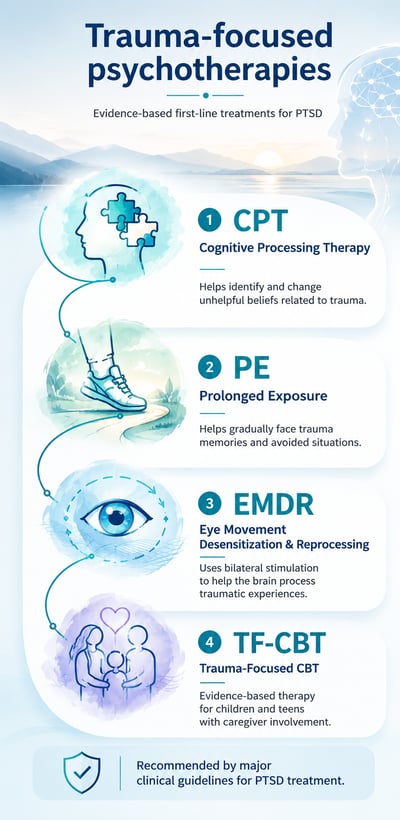
Major clinical guidelines - including those from the U.S. Department of Veterans Affairs and Department of Defense, the American Psychological Association, and the International Society for Traumatic Stress Studies - converge on the same set of first-line treatments for PTSD. These treatments have the strongest research base, and they should be the starting point of any treatment plan developed with a healthcare provider.
Trauma-focused psychotherapies
Cognitive Processing Therapy (CPT)
A 12-session structured therapy that helps the person identify and shift unhelpful beliefs that developed after the trauma - beliefs about safety, trust, power, esteem, and intimacy. CPT has decades of research support, including in veteran populations, and is one of the two trauma- focused therapies most strongly recommended by the VA.
Prolonged Exposure therapy (PE)
Also a structured short-term therapy, PE helps the person gradually approach trauma memories and safe but avoided situations. The goal is to allow the brain and body to process what happened so that reminders no longer trigger the full survival response. PE has a robust evidence base and is widely available through trained therapists.
Eye Movement Desensitization and Reprocessing (EMDR)
EMDR uses structured bilateral stimulation, typically eye movements, while the person briefly recalls trauma material. Many clients prefer EMDR because it requires less verbal recounting of the trauma than CPT or PE. EMDR has a substantial evidence base and is recommended by the VA, APA, and World Health Organization for PTSD.
Trauma-focused cognitive behavioral therapy (TF-CBT)
TF-CBT is an evidence-based therapy specifically for children and adolescents with PTSD,
delivered with the involvement of a caregiver. It combines trauma-narrative work with skills for affect regulation and cognitive reframing.
Medication
Medication can be helpful, especially when paired with trauma-focused therapy. Two medications — sertraline and paroxetine — are FDA-approved for PTSD in adults. Other selective serotonin reuptake inhibitors (SSRIs) and serotonin-norepinephrine reuptake inhibitors (SNRIs) are commonly prescribed off-label. Prazosin is sometimes prescribed for trauma related nightmares, though clinical guidelines are mixed. Decisions about medication should always be made with a prescribing healthcare provider who knows the full clinical picture.Other supports
Sleep treatment is essential and often the fastest source of relief. Cognitive Behavioral Therapy for Insomnia (CBT-I) is the evidence-based first-line treatment for the sleep problems that come with PTSD.
Group therapy can reduce isolation and shame, particularly for veterans and first responders. Couples and family therapy may help when relationships have been strained. Body-based approaches such as Somatic Experiencing or yoga therapy are increasingly used as adjuncts; the research base is growing but is not yet as deep as for the trauma-focused psychotherapies above.
What the research actually says
The research base for neurofeedback in PTSD has grown meaningfully over the past two decades, but it remains smaller than the research base for CPT, PE, and EMDR. Several findings are worth knowing.
A 2016 randomized controlled trial by Bessel van der Kolk and colleagues at the Trauma Center found that 24 sessions of neurofeedback reduced PTSD symptoms more than a waitlist control group in adults with chronic, treatment-resistant PTSD. Effect sizes were clinically meaningful, and gains were largely maintained at follow-up.
Earlier work by Peniston and Kulkosky in the 1990s with combat veterans reported substantial improvement in PTSD symptoms and substance use following alpha-theta training, though these studies had methodological limitations by current standards.
More recent reviews have concluded that neurofeedback shows promise for PTSD and may be appropriate for adults who have not fully responded to first-line treatments, but they consistently note the need for larger, well-controlled trials. Neurofeedback is not currently recommended by the VA or APA as a first-line PTSD treatment.

The takeaway is straightforward. If you are not yet in trauma-focused therapy with a healthcare provider, that is the place to start. If you are in trauma-focused therapy and looking for an adjunct that may help with arousal, sleep, or tolerance for the work, neurofeedback is one reasonable option to discuss with your provider.
What our home neurofeedback program looks like
Our home program is designed to be a supervised, clinically grounded experience - not a do-it- yourself kit. Every program is overseen by a member of our clinical team. Learn more about our supervised home neurofeedback rental program. See what home neurofeedback looks like day-to-day for more on daily setup and sessions.
Step 1 - Consultation
We start with a 20-minute consultation to understand what you are working on, what trauma care you are currently engaged in, and whether a home neurofeedback program is a reasonable next step. If we do not think we are the right fit, we will tell you and suggest where to look instead.
Step 2 - Clinical intake and program design
If we move forward, you complete an intake with one of our clinicians. We coordinate with your current trauma therapist or healthcare provider whenever possible - with your written
permission - so that the brain training plan supports the work you are already doing. The clinician designs a training program based on your clinical picture, your goals, and your
provider's input.

Step 3 - In-home setup and weekly sessions
Equipment is delivered and you are guided through a simple set-up. Learning how to use the equipment takes 15 minutes. Your clinician walks you through the training routine and sets your weekly session schedule.
Step 4 - Monthly check-ins
You meet monthly with your clinician by video or phone to answer any questions and review progress as reflected in self reporting and the self-assessment tools.
Step 5 - Re-assessment and decision
At the end of your initial program (typically 12 to 20 weeks), we re-assess together. Many clients complete the program at that point and continue with their trauma therapy. Some choose to extend. Some find they have what they need and move on. We help you make the decision that fits your clinical situation, not our calendar.
Who our program is and isn't for
We work with adults, teens, and children who have a PTSD or trauma diagnosis from a licensed healthcare provider and who are already engaged in, or have completed, trauma-focused therapy. Neurofeedback works best as part of a coordinated plan, not as a substitute for clinical care.
Adults we typically work with
- Adults with chronic PTSD whose progress in trauma therapy has plateaued and whose provider supports adding neurofeedback as an adjunct
- Veterans and active service members with combat- or service-related PTSD, working with a VA provider or community trauma specialist
- First responders - firefighters, EMS, police, ER and ICU staff - with cumulative occupational trauma
- Survivors of motor vehicle collisions, medical trauma, or community violence, working with a trauma therapist
- Adults with prominent sleep disruption and hyperarousal symptoms, alongside their primary trauma care
Children and adolescents can develop PTSD after abuse, accidents, medical trauma, loss, or community or family violence and they often show it differently than adults do. Instead of describing flashbacks, a younger child may become more irritable or clingy, regress to earlier behaviors, have trouble sleeping, replay the event in play, or struggle with big emotions that seem out of proportion to the moment. Teens may withdraw, take risks, or appear angry rather than frightened. A child trauma specialist can help you understand what you are seeing.
As with adults, the evidence-based first-line treatment comes first. For children and teens, that is trauma-focused cognitive behavioral therapy (TF-CBT), delivered with a caregiver involved. Neurofeedback is an adjunct - something families sometimes add alongside therapy, with the child's provider in the loop - not a replacement for it.
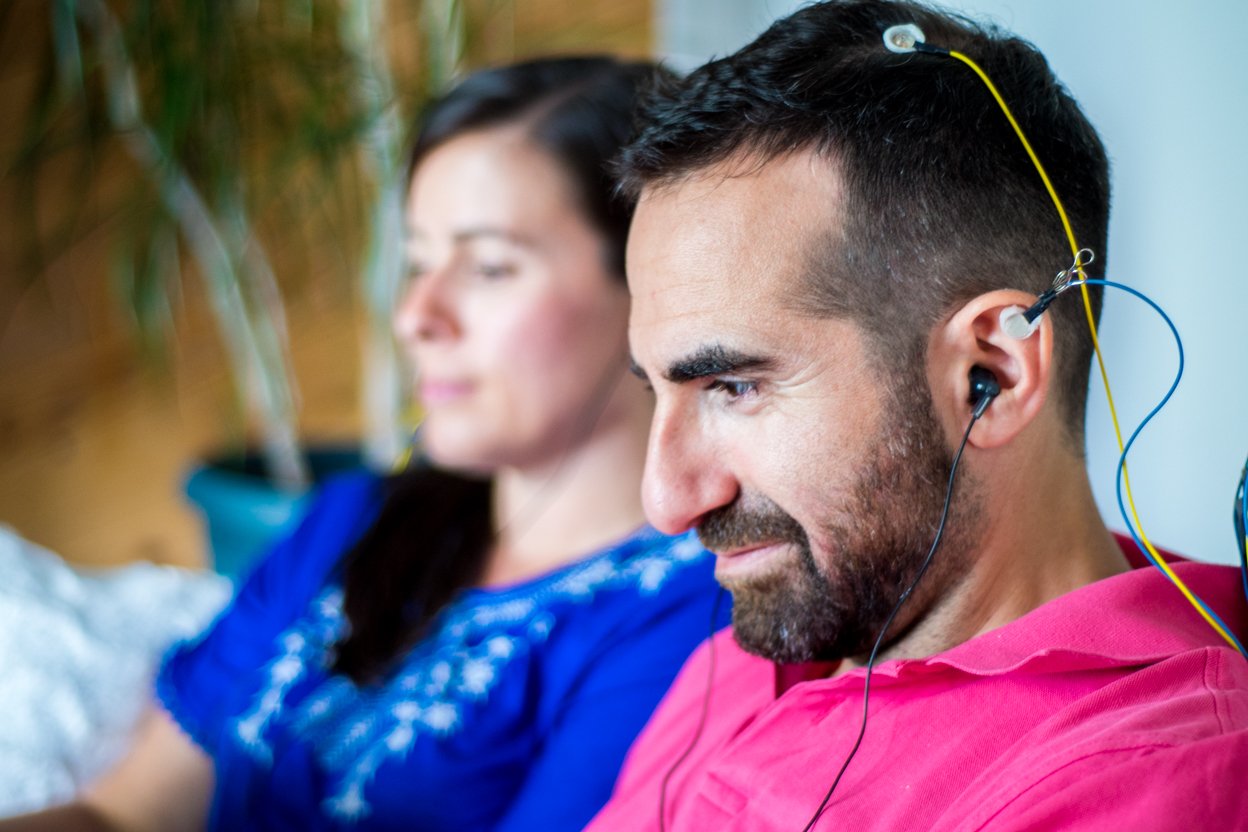
Many parents are drawn to neurofeedback for their child precisely because it is non-invasive and non-pharmaceutical. There are no needles and no medication. The child simply watches a video or plays a game while small sensors rest on the scalp and read brain activity; the program gently rewards the brain for shifting toward a calmer, more regulated state. For families who are cautious about starting medication in a child, or who want to add a gentle, skills-building support alongside therapy, that matters.
The goal parents most often describe is emotional regulation and stability - a longer fuse, fewer meltdowns, smoother transitions, calmer bedtimes, and more room between a trigger and a reaction. Neurofeedback supports the brain's capacity to self-regulate, which is the same capacity trauma can disrupt in a developing nervous system.
When we work with a child or teen, a parent or guardian is involved throughout, and we coordinate directly with the child's therapist or healthcare provider - with your written permission - so the brain training plan supports the clinical work already underway. For very young children, or where a child is in acute distress or crisis, we will refer to a child trauma specialist rather than begin a home program.
Who is not a fit for a home neurofeedback program
There are people for whom a home neurofeedback program is not appropriate. We will tell you on the consultation if this is the case, and we will suggest where to look instead. In some cases that includes our in-person NYC sessions.
• Anyone with active suicidal ideation, recent suicide attempts, or active self-harm behaviors. Crisis support comes first; please see the resources at the end of this section.
• Anyone whose PTSD has not yet been diagnosed or treated by a licensed healthcare provider - start there.
• Anyone with severe, untreated PTSD without an active treatment plan and a clinician overseeing care.
• Very young children, or any child or teen in acute distress or crisis, should first be evaluated by a child trauma specialist.
If you are in crisis
If you are having thoughts of suicide or self-harm, or you feel unsafe right now, please reach out to people who can help immediately.
988 Suicide & Crisis Lifeline — call or text 988 (United States)
Veterans Crisis Line — call 988 and press 1, text 838255, or chat at veteranscrisisline.net
RAINN National Sexual Assault Hotline — 1-800-656-HOPE (4673)
Crisis Text Line — text HOME to 741741
Or go to your nearest emergency room. You do not have to wait until things get worse.
Can neurofeedback cure my PTSD?
No. Neurofeedback is a brain training method, not a cure for PTSD. Some adults with PTSD
experience meaningful symptom reduction with neurofeedback, particularly when it is used
alongside trauma-focused therapy and care from a licensed healthcare provider. Others see
modest benefit. A small portion do not respond. We will tell you what is realistic to expect based
on your clinical picture.
Can I do this instead of trauma therapy?
We do not recommend it, and in most cases we will not enroll someone in our program who is
not already working with a trauma therapist or healthcare provider for their PTSD. The
evidence-based first-line treatments for PTSD are trauma-focused psychotherapies — CPT, PE,
EMDR — and these should not be skipped in favor of neurofeedback.
Does insurance cover the program?
Our home program is self-pay. Many clients use HSA or FSA funds with a clinician's letter of
medical necessity. Some submit superbills to insurance for partial reimbursement, depending on plan and provider. Our team can provide the documentation.
I am a veteran. Will this affect my VA benefits or care?
No - using our private home program does not change your eligibility for VA services or
benefits. We strongly encourage veterans to continue any VA mental health care alongside
neurofeedback work. With your written permission, we can share progress reports with your VA provider so your care stays coordinated.
How long until I might notice changes?
Some clients notice changes — often in sleep or general activation — within the first three to
five weeks. Others take longer. The full clinical program runs 12 to 20 weeks. Substantial
change in PTSD symptoms typically requires sustained training, not a handful of sessions.
Can I use neurofeedback while taking PTSD medication?
Yes. Adults often continue their prescribed medications throughout neurofeedback training. Do not adjust or stop any medication without consulting the healthcare provider who prescribed it. As your symptoms shift, your prescriber may want to revisit your regimen — that is a conversation for them, not for us.
What if I have complex trauma or C-PTSD
Adults with Complex Trauma can benefit from neurofeedback, but the work typically proceeds
more slowly if they are not in adjacent trauma therapy and depends on having a trauma-trained therapist actively involved in your care. We will discuss your situation in the consultation and may recommend a longer initial program. For those who have already engaged in trauma therapy, neurofeedback is a helpful support for nervous system regulation.
Can you help my child or teen with trauma?
Yes, in the right circumstances. We work with children and teens who have a trauma or PTSD
diagnosis, when a trauma-trained therapist is actively involved and a parent or guardian
participates throughout. Many parents choose neurofeedback because it is non-invasive and
non-pharmaceutical — no needles, no medication, just the child watching a video or playing a game while sensors read brain activity. It is used as an adjunct that supports emotional regulation, not as a replacement for trauma-focused therapy such as TF-CBT. Very young children, or any child in crisis, should be evaluated by a child trauma specialist first.
Will my therapist support adding neurofeedback?
Many trauma therapists are familiar with neurofeedback and supportive of it as an adjunct;others are unfamiliar but open. We are glad to send your therapist information about our program and our approach. Coordination of care is part of how we work.
If you are considering our program
The simplest place to start is a 20-minute consultation. We will talk through what you are
working on, where you are in your current care, and whether a home neurofeedback program is
a reasonable next step. If it is not the right fit, we will tell you, and we will suggest where to look
instead.

Important note about this information
This page is intended to support your conversation with a licensed healthcare provider. It is not medical advice and not a substitute for diagnosis, treatment, or clinical judgment from a qualified clinician. Neurofeedback is a brain training method. The neurofeedback equipment we provide is not FDA-approved for the diagnosis or treatment of any specific condition, including PTSD. Individual results vary. If you are experiencing a mental health crisis, please call or text
988 (or call 988 and press 1 if you are a veteran), text HOME to 741741, or go to your nearest emergency room