Neurofeedback for Depression: Brain Training & Mood Regulation
Neurofeedback is a form of brain training, not a treatment for depression. Some people use it alongside therapy, medication or both to support mood regulation, sleep and recovery from stress. The research is promising in places and mixed in others, and this page sets out both.
This guide explains what neurofeedback is, what studies on depression have found, what changes people commonly report, how long a program takes, what it costs, and where it fits with other care.
Licensed Psychotherapist · Advanced NeurOptimal® Trainer · Amen Clinic Brain Health Coach
Natalie has over 25 years of experience as a licensed psychotherapist and has been a NeurOptimal® neurofeedback trainer since 2011. She is the founder of Neurofeedback Training Co. and specializes in anxiety, trauma, ADHD, and stress-related nervous system dysregulation.
.png)
If you are in crisis or thinking about suicide, call or text 988 (the Suicide & Crisis Lifeline, US) or go to your nearest emergency room. Neurofeedback is not a substitute for urgent or ongoing mental health care.
What is neurofeedback brain training?
Neurofeedback, also called EEG biofeedback, gives the brain real-time information about its own electrical activity. Sensors placed on the scalp read brainwave activity. Software then responds through sound or visuals, and the brain uses that information to adjust its patterns over repeated sessions.
The sensors only read activity. Nothing is sent into the brain: no electrical current, no magnetic pulses and no medication. This is what separates neurofeedback from brain stimulation approaches such as TMS (transcranial magnetic stimulation), which is a medical treatment for depression delivered by a physician.
The idea behind neurofeedback is learning, not correction. With repetition, the brain gets practice at shifting states more flexibly, which is why results build gradually rather than appearing after one session. For a fuller history, see the history of neurofeedback.

Depression and Brain Regulation
Depression is a medical condition with many contributing factors, including genetics, life events, chronic stress, sleep, physical health and relationships. It needs a proper assessment from a doctor or licensed mental health professional, and no brain-training system can diagnose it.
Researchers have looked for EEG patterns that differ in people with depression. The most studied is frontal alpha asymmetry, a difference in alpha activity between the left and right front of the brain. Findings have been inconsistent from study to study, so these patterns describe group averages rather than a test for any one person.
What many people with depression describe is a nervous system that feels stuck: low energy and motivation, poor sleep, rumination, slow recovery after setbacks. Neurofeedback is aimed at regulation and flexibility rather than at depression itself. That is why it is best thought of as one support among several, not a direct fix.
Two generations of neurofeedback (and where consumer headsets fit)
Three quite different things are sold as “neurofeedback,” and they are worth separating before looking at the research.
|
Type |
How it works |
Who runs it |
Relevance to depression |
|
Protocol-based (linear) |
A clinician picks a target, such as shifting alpha balance between the left and right frontal areas, and the software rewards movement toward it. Often starts with a QEEG brain map. |
Trained clinician sets and revises the protocol |
Most of the published depression studies use this approach |
|
Dynamical (non-linear), e.g. NeurOptimal® |
Monitors a wide frequency range and briefly interrupts the audio when it detects sudden shifts in brain activity. Sets no target and pushes toward no state. |
Can be used at home with guidance; no protocol to configure |
Fewer published studies; used for regulation broadly rather than for a depression-specific target |
|
Consumer headsets (Muse, Mendi and similar) |
Dry sensors on a headband, usually Bluetooth, with app-based feedback for meditation or focus |
Self-guided |
Designed for wellness practice; not tested as depression support |
If you are comparing specific systems and prices, see Home Neurofeedback Systems Compared. For more on the two approaches, see Protocol vs Dynamical Neurofeedback.
How a Dynamical neurofeedback session works
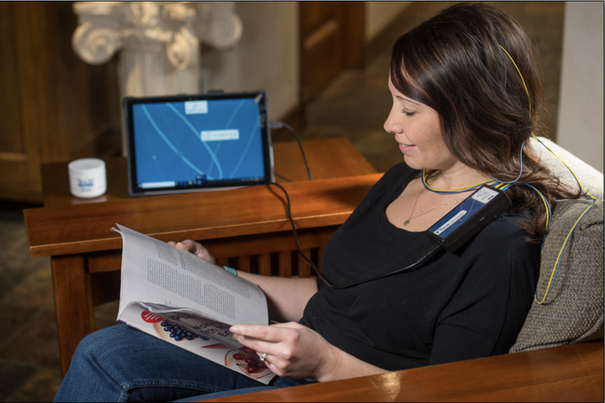
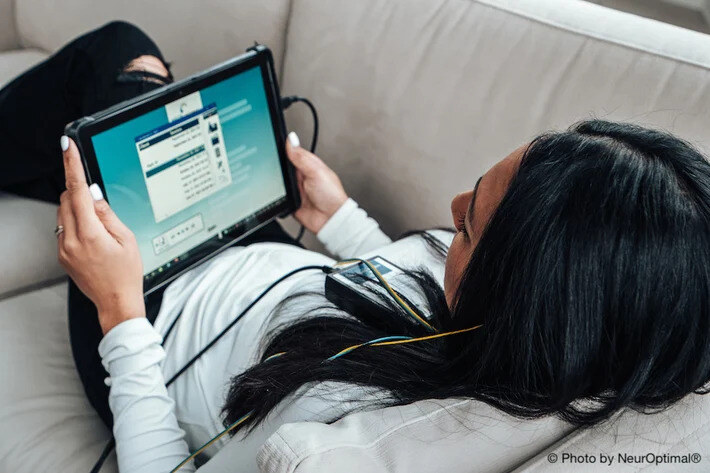
A NeurOptimal® session takes about 30 minutes and asks very little of you. There is nothing to concentrate on and no task to perform, which matters when energy and motivation are low.
- Two sensors are placed on the scalp and clips on the ears, with a small amount of conductive paste.
- You put on headphones and sit or lie back comfortably. Many people close their eyes or rest.
- Music plays. When the system detects a sudden shift in brain activity, the music briefly pauses.
- The brain registers these tiny interruptions and, over many sessions, gets practice at returning to a steadier state.
- Afterward, most people feel relaxed or simply normal. Some feel tired for a few hours.
To learn what a first session is like, see What to Expect from Your First NeurOptimal® Session
What Does the Research Say?
Reviews of the research find that neurofeedback is associated with reduced depressive symptoms, but the studies are small, varied in method and often not well blinded. Researchers describe it as promising, not proven.
|
Review |
What it looked at |
What it found |
|
Meta-analysis of 22 studies in major depressive disorder |
Moderate reduction in depression symptoms; longer programs were linked to better outcomes. The authors call it a promising non-medication option. |
|
|
Meta-analysis of neurofeedback and heart-rate-variability biofeedback for depression |
Associated with lower self-reported depression. The authors say study quality leaves large room for improvement, and see these as possible complementary approaches. |
|
|
Systematic review of 13 experimental studies |
Symptoms decreased in some participants, but not everyone responded and few improved substantially on depression scales. More studies needed. |
Three cautions matter when reading these results:
- Placebo and expectation effects are hard to rule out. Fewer studies compare real neurofeedback with a convincing sham, and those comparisons tend to show smaller differences.
- Most studies use protocol-based training. We are not aware of controlled trials testing NeurOptimal® specifically for depression. What we can share about it comes from clinical experience and client reports, which are not the same as trial evidence.
- Neurofeedback is not FDA-cleared to treat depression. Treatments with that status, such as certain medications and TMS, have a larger evidence base.
In short: the research supports neurofeedback as a reasonable thing to explore alongside established care, not as a replacement for it.
What results can you realistically expect?
Changes, when they come, tend to be gradual and uneven, and some people notice little. A common estimate in practitioner literature is that 15 to 30 percent of people do not respond to neurofeedback with any approach.
The changes people most often report first are not mood itself but the things around it:
- Sleep: falling asleep more easily or waking less often
- Energy: mornings that feel less heavy
- Rumination: thoughts that loop less or let go sooner
- Recovery: bouncing back faster after a stressful day
- Reactivity: small things that used to tip the day over feeling more manageable
Mood shifts, if they follow, usually come after these and build over weeks. Progress is rarely a straight line; a good week followed by a flat one is normal. See Why Neurofeedback Results Aren’t Linear.
It helps to track two or three specific things from the start, such as hours slept, a daily 1–10 mood rating, or how long a low patch lasts. Share these with your therapist or doctor so changes are judged against a baseline rather than memory.
- Effect sizes vary substantially by study, by system type, and by population.
- Neurofeedback is not considered a standard first-line medical treatment for anxiety disorders. It is best understood as brain training that may complement CBT, psychotherapy, lifestyle changes, or medication when appropriate.
- Neurofeedback is not FDA-approved as a treatment for anxiety. It is regulated as a wellness practice for general brain training, not as a medical device for anxiety disorders.
The strongest predictor of benefit appears to be consistent participation in a properly-supervised program - regardless of which type of system is used nd integration with broader anxiety care.
What results can you realistically expect?
Changes, when they come, tend to be gradual and uneven, and some people notice little. A common estimate in practitioner literature is that 15 to 30 percent of people do not respond to neurofeedback with any approach.
The changes people most often report first are not mood itself but the things around it:
- Sleep: falling asleep more easily or waking less often
- Energy: mornings that feel less heavy
- Rumination: thoughts that loop less or let go sooner
- Recovery: bouncing back faster after a stressful day
- Reactivity: small things that used to tip the day over feeling more manageable
Mood shifts, if they follow, usually come after these and build over weeks. Progress is rarely a straight line; a good week followed by a flat one is normal. See Why Neurofeedback Results Aren’t Linear.
It helps to track two or three specific things from the start, such as hours slept, a daily 1–10 mood rating, or how long a low patch lasts. Share these with your therapist or doctor so changes are judged against a baseline rather than memory.
Who might brain training be a fit for?
Neurofeedback may be worth exploring if you:
- Are already working with a therapist, doctor or both, and want something to add to that care
- Have mild to moderate low mood alongside poor sleep, stress or rumination
- Feel you understand your patterns in therapy but your body still stays stuck
- Prefer a non-medication option to explore alongside, or before discussing, other approaches with your prescriber
- Can commit to regular sessions over two to four months
Talk to your doctor or psychiatrist first if any of these apply:
- Severe depression, or any thoughts of suicide or self-harm. Get urgent care first; 988 is available 24/7 in the US.
- Bipolar disorder or a history of mania, since changes in sleep and energy need closer monitoring
- A seizure disorder or recent head injury
- You are taking medication that may need adjusting as things change
Neurofeedback does not replace an assessment, therapy or medication that a clinician has recommended.
At-home Dynamical neurofeedback for Depression
Training at home removes the hardest part of a program when mood is low: getting to appointments. Most people train three to five times a week, and frequency is one of the factors most linked to progress. Many complete 20 to 40 sessions before judging whether it is helping, and 40 to 60 for more settled change.
Our home rental is a professional NeurOptimal® system, the same equipment clinicians use. It is fully automated: no protocol to choose and no brain map needed. Every rental includes a weekly 1:1 coaching call with a certified trainer, four per rental month, so someone is checking in on how training is going.
Cost and time commitment
|
Option |
Price |
What it includes |
|
Home rental, Essential |
$650 per 28-day month |
12 sessions, 1 person, weekly coaching |
|
Home rental, Elite |
$799 per 28-day month |
Unlimited sessions, up to 6 people, weekly coaching |
|
Home rental, 3 months |
$699 per month |
Unlimited sessions, 3-month commitment, weekly coaching |
|
In-office, NYC |
$150 per session, or $1,150 for 10 |
Sessions at 32 Union Square East |
|
Buy a system |
$5,995–9,995 |
For long-term or household use |
Shipping for rentals is $35 each way. A typical two- to four-month program runs $1,400–3,300. Neurofeedback is generally not covered by insurance; some people use HSA or FSA funds, so check with your plan administrator. See all programs and costs.
How brain training fits alongside other depression support
|
Option |
Typical cost |
Time commitment |
|
In-clinic neurofeedback |
$3,000 - $12,000 for full program |
Travel + 30-min session, 3-5x/week |
|
At-home Dynamical rental (with coaching) |
Starting at $650/month, all-inclusive |
30-min session at home, 3-5x/week |
|
Consumer-tier headsets |
$300 - $1,500 device + apps |
Self-directed, varies |
Neurofeedback is generally not covered by insurance for anxiety because it is not FDA-approved as a treatment. Some clinics offer HSA/FSA eligibility under certain conditions; check with your specific plan provider.
How brain training fits alongside other depression support
Neurofeedback works best as one part of a plan, not the whole plan.
- Therapy. Therapy works with thoughts, relationships and meaning; neurofeedback works with patterns of brain activity. Many people find the two complement each other. Let your therapist know you are training, especially if trauma is part of the picture.
- Medication. Neurofeedback can be used while taking antidepressants. Never stop or reduce medication on your own. Any change should be decided with your prescriber, who can watch for withdrawal effects or a return of symptoms.
- Other medical treatment. If you are considering TMS or another physician-delivered treatment, ask your doctor about timing before combining approaches.
- Daily foundations. Sleep, movement, daylight, food and contact with other people all affect mood. Neurofeedback does not replace them, and changes in sleep often make them easier to keep up.
Frequently asked questions about neurofeedback for depression
Does neurofeedback work for depression?
Reviews of the research find it is associated with reduced depressive symptoms, but the studies are small and not always well controlled. Not everyone responds. It is reasonable to explore alongside established care, not as a replacement.
Is Neurofeedback a treatment for depression?
No. Neurofeedback is brain training. It is not FDA-cleared to treat depression and does not diagnose or cure it. Some people use it to support regulation, sleep and stress recovery while receiving care from a doctor or therapist.
Can Neurofeedback Replace Antidepressants?
No. Do not stop or reduce medication because you have started neurofeedback. Any change to medication should be made with your prescriber.
Can I do neurofeedback while taking antidepressants?
Yes. Neurofeedback does not interact with medication the way another drug would. Tell your prescriber you are training so they can account for any changes in sleep, energy or mood.
How long does a neurofeedback program for anxiety take?
Most anxiety-focused neurofeedback programs run 8 to 16 weeks. Sessions are typically about 33 minutes long, completed 2 to 4 times per week. Some individuals notice changes within 10 to 20 sessions; more sustained shifts typically require 30 or more sessions.
How long does a neurofeedback program for depression take?
Most people train three to five times a week for two to four months. Many complete 20 to 40 sessions before judging whether it helps.
How much does neurofeedback for depression cost?
A home rental is $650–799 per month, and a typical program runs $1,400–3,300. In-office sessions in NYC are $150 each, or $1,150 for 10.
Is neurofeedback for depression covered by insurance?
Generally not. Some people use HSA or FSA funds; check with your plan administrator.
Can I do neurofeedback for depression at home?
Yes. A professional NeurOptimal® system can be rented for home use, with weekly coaching calls from a certified trainer. No protocol setup or brain map is needed.
Is neurofeedback safe?
Neurofeedback is non-invasive. The sensors only read brain activity; nothing is sent into the brain. Some people notice temporary tiredness, headache or emotional shifts after a session, which usually pass within hours.
Can neurofeedback make depression worse?
Serious side effects are uncommon, but some people feel temporarily more tired or emotional as training begins. If your mood worsens, pause training and talk to your doctor or therapist. If you have thoughts of suicide, call or text 988.
How is neurofeedback different from TMS?
TMS uses magnetic pulses to stimulate the brain and is an FDA-cleared treatment for depression, given by a physician. Neurofeedback stimulates nothing; it reads brain activity and gives feedback.
Can neurofeedback help with depression and anxiety together?
The two often occur together, and people commonly train for both at once. See our page on neurofeedback for anxiety.
Exploring neurofeedback as part of your depression support?
A free consultation can help you decide whether brain training makes sense for your situation, how it would fit with the care you already have, and whether home or in-office training suits you better.